Contract value leakage is the gap between the value an organisation negotiates into a contract at signature and the value it actually realises over its lifetime. It occurs post-signature, through missed obligations, unenforced clauses, untracked entitlements, and price adjustments that were agreed but never applied. World Commerce and Contracting (WorldCC) research published in February 2026 puts the industry average at 11% of total contract value. On $500 million of managed spend, that is $55 million walking out of the business every year.
Key takeaway: Enterprises lose 11% of contract value post-signature. Not through poor negotiation. Through a structural data visibility failure that most organisations have not yet named, let alone fixed.

Most organisations focus their entire procurement energy on one moment: the deal. The negotiation. The signature. The savings percentage announced internally. Then the contract is filed, the team moves to the next initiative, and the value inside that signed document starts leaking.
Not dramatically. Quietly. Continuously. In obligations that were written in but never enforced. In entitlements that were negotiated but never claimed. In rate adjustments that existed on paper but were never applied.
The number that captures this is 11%.
WorldCC's research shows it is not a rounding error. It is not the result of poor contracts or weak suppliers. It is the predictable outcome of an enterprise-wide structural failure: the functions with commercial expertise exit at the moment they are most needed, which is the point of signature, while the functions responsible for delivery lack the tools, context, and mandate to protect value across the contract's lifetime.
Knowing this number exists is where most procurement leaders are today. Acting on it is where the leaders separating from the pack are going.
Percentages are easy to absorb and then set aside. Dollars are not.
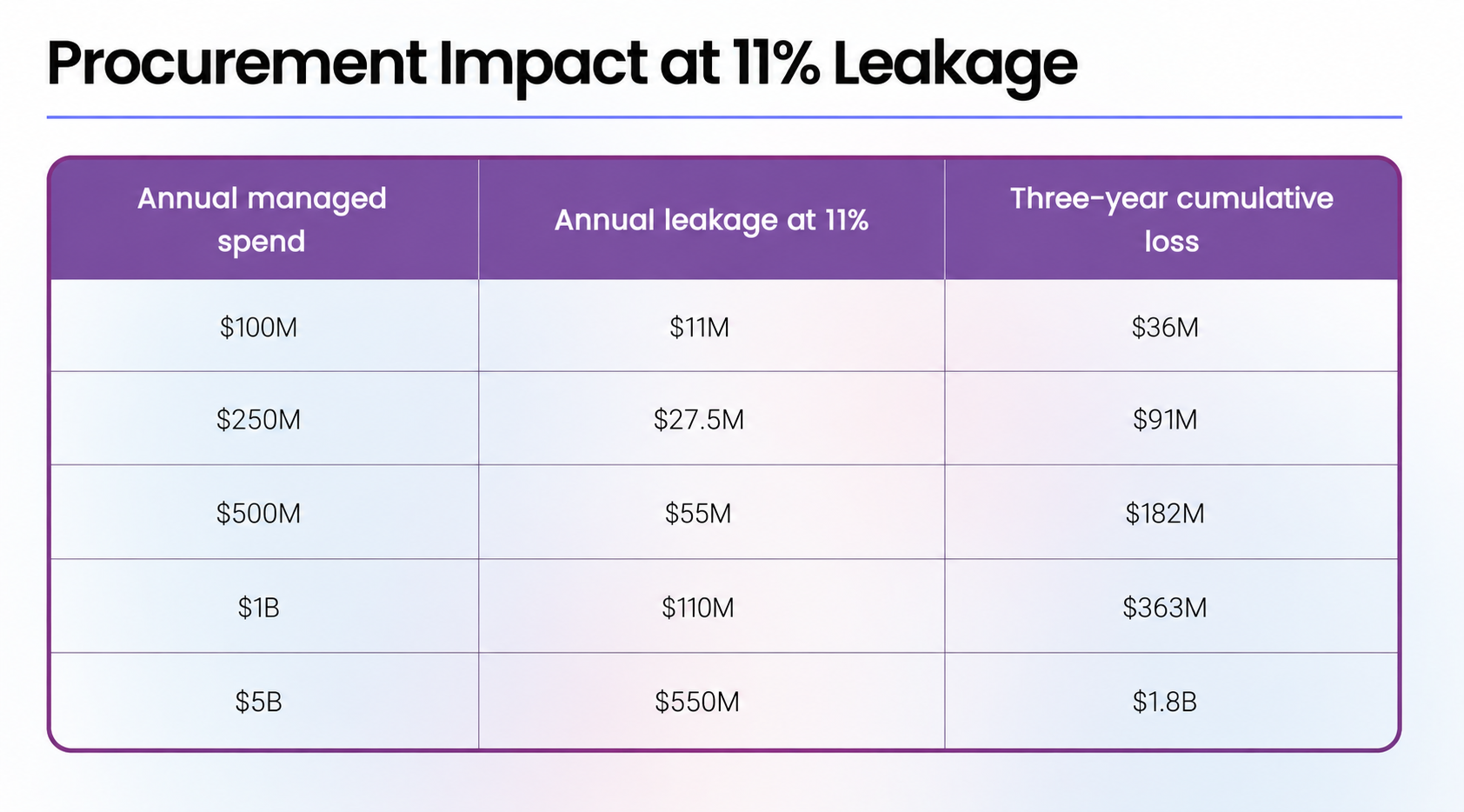
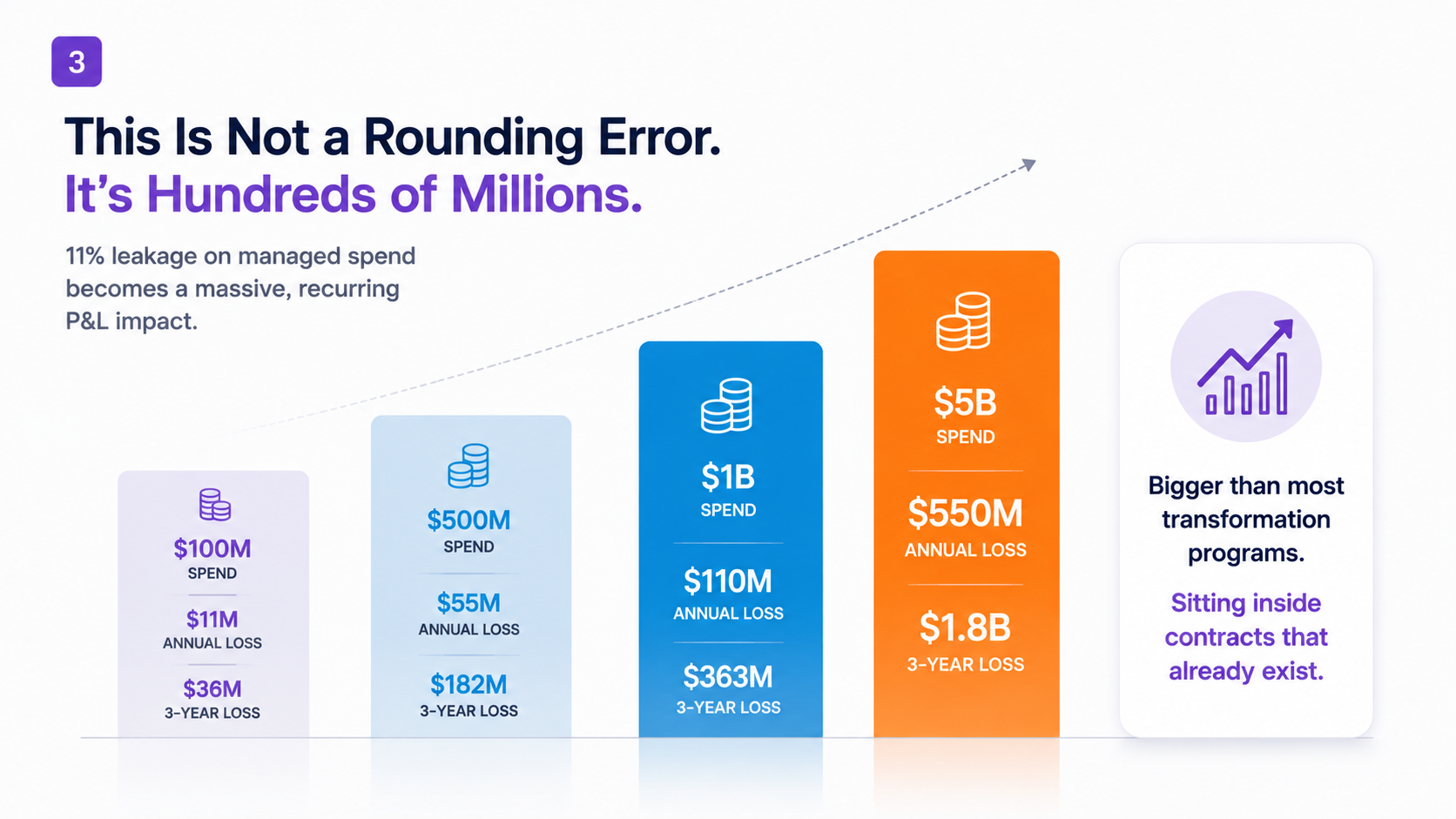
On $5 billion of managed indirect spend, 11% post-signature contract value leakage is $550 million. Per year. That is not a one-time event. It is a recurring P&L impact that compounds for as long as the contracts run and the obligations inside them go unenforced.
On a single $200 million Master Service Agreement, the same rate is $22 million. On a three-year $150 million oilfield services contract, it is $49.5 million across the contract term, on a deal where procurement almost certainly celebrated a strong negotiated outcome at signature.
The CFO does not need to be convinced this is worth attention. They need to be shown how to recover it, and how fast.
Bigger than most digital transformation programmes your organisation has run. Sitting inside contracts that already exist.
WorldCC's finding does not stand alone.
McKinsey published research in 2026 showing that 55% of procurement leaders are operating with flat or shrinking budgets even as savings targets continue to increase. The pressure to recover value from existing commitments has never been higher, and post-signature leakage is the largest unaddressed pool of that value in most organisations.
KPMG, reporting with Forbes Insights in 2025, found that 78% of organisations have no single source of truth with established governance for managing their contract inventory. That is not a technology gap. It is a visibility gap. And visibility is precisely what post-signature contract value leakage exploits.
Hackett Group's 2025 research shows that Digital World Class procurement organisations deliver 2.6 times greater return on investment than their peers, operating with 31% fewer full-time employees and at 19% lower cost as a percentage of spend. The gap between top-quartile and median procurement organisations is not closing. Obligation management is one of the primary mechanisms separating them.
This is not a fringe finding. It is an industry consensus that procurement leadership has identified, discussed, and largely not yet operationalised. The gap between knowing the number and closing it is the opportunity.
Understanding that 11% leaks post-signature is useful. Understanding why it leaks is what makes it fixable.
The answer is a data problem. Not a contracts problem.
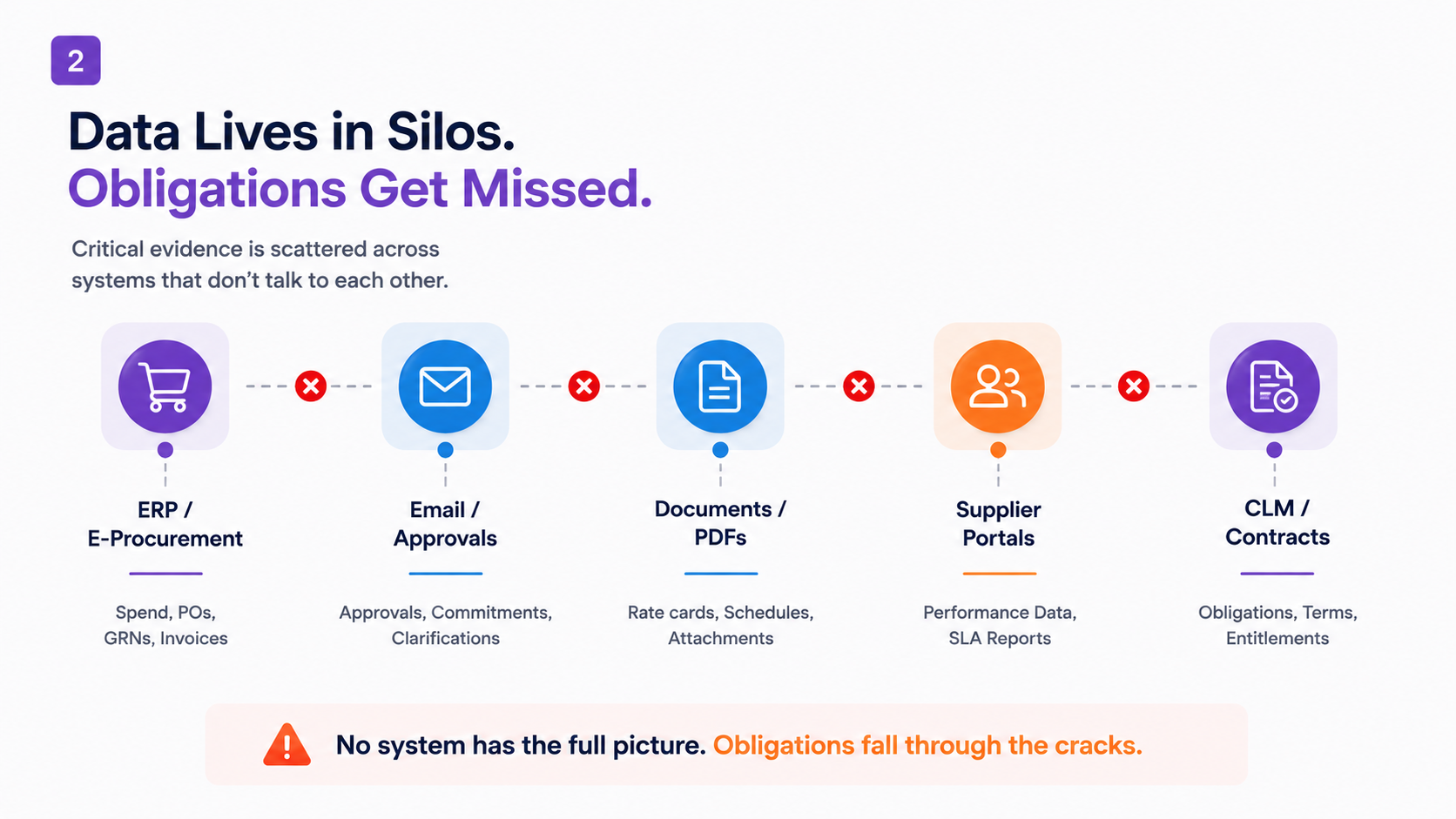
The contracts are largely sound. Obligations are negotiated and documented. Entitlements are written in. Enforcement mechanisms exist. The failure is in the evidence trail required to enforce those obligations, and in where that evidence lives.
Consider a rebate agreement with a major supplier. The contract specifies that a volume rebate triggers when cumulative purchases cross $10 million in a twelve-month period. That threshold is reached in month nine. The evidence that it was reached sits in the ERP system. The rebate clause sits in the contract management platform. The approval confirming the final purchase sits in an email thread. No system sees all three. No claim is generated. The rebate expires unclaimed. The supplier does not volunteer the information.
This pattern repeats across every contract surface where value leaks.
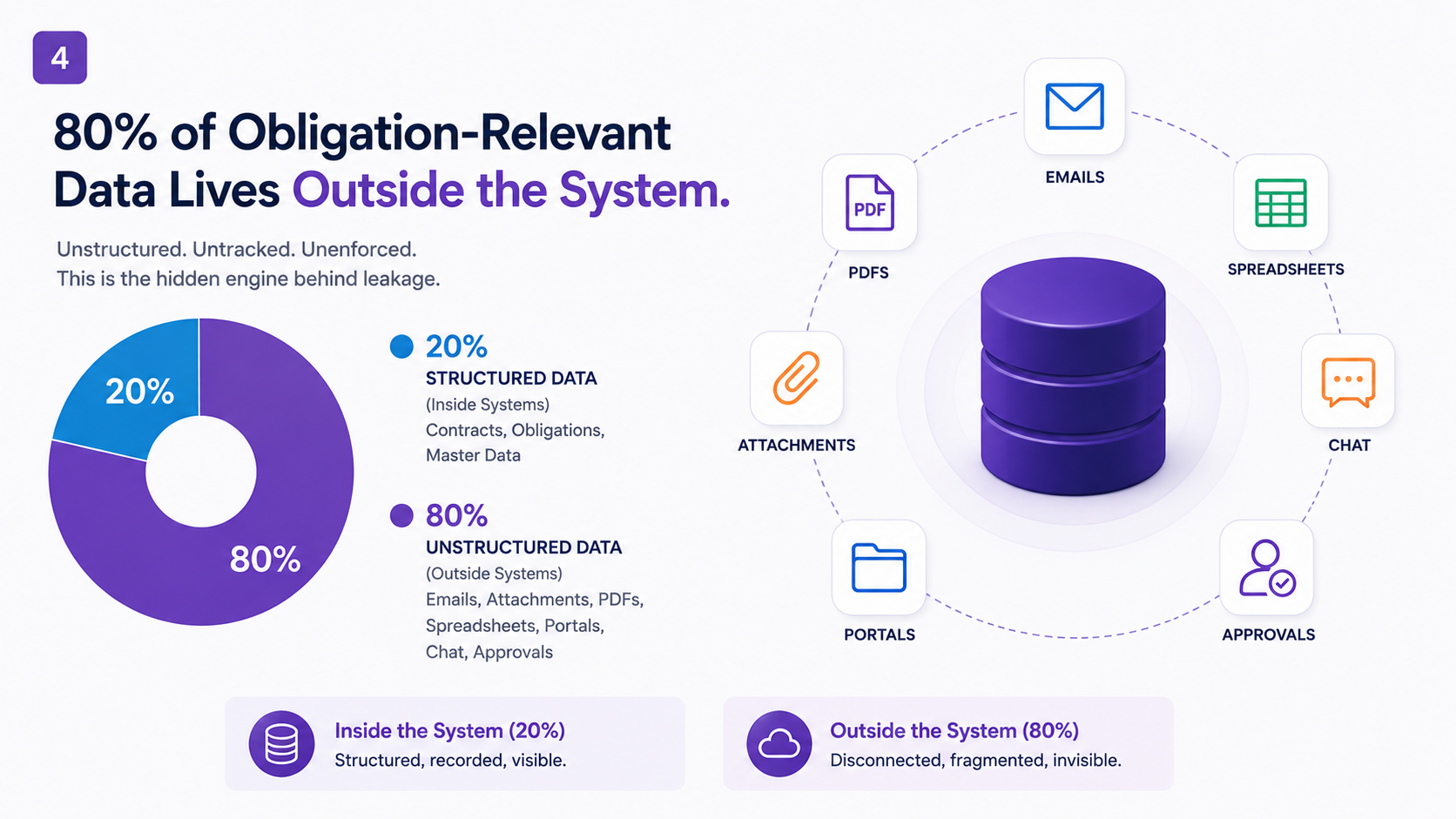
Based on Emplay's analysis of enterprise contract portfolios, approximately 80% of the evidence required to enforce a contract obligation lives outside the system of record designed to track it. Email approval chains. Supplier portals. Carrier APIs. Rate card PDFs. Field confirmations. The structured data inside Ariba, Coupa, and every major CLM on the market represents roughly 20% of the evidence trail a contract actually requires.
The other 80% is disconnected, fragmented, and invisible to every platform your organisation paid to manage contracts.
The industry has spent decades measuring procurement performance at the point of award. Negotiated savings. Spend under management. Contract compliance at signature. These are useful measures. They are incomplete ones. The moment that determines whether negotiated value is actually realised is not award. It is every moment after award, across the full lifecycle of every obligation inside every contract, until each one has been enforced, claimed, or expired.
Emplay built for that moment.
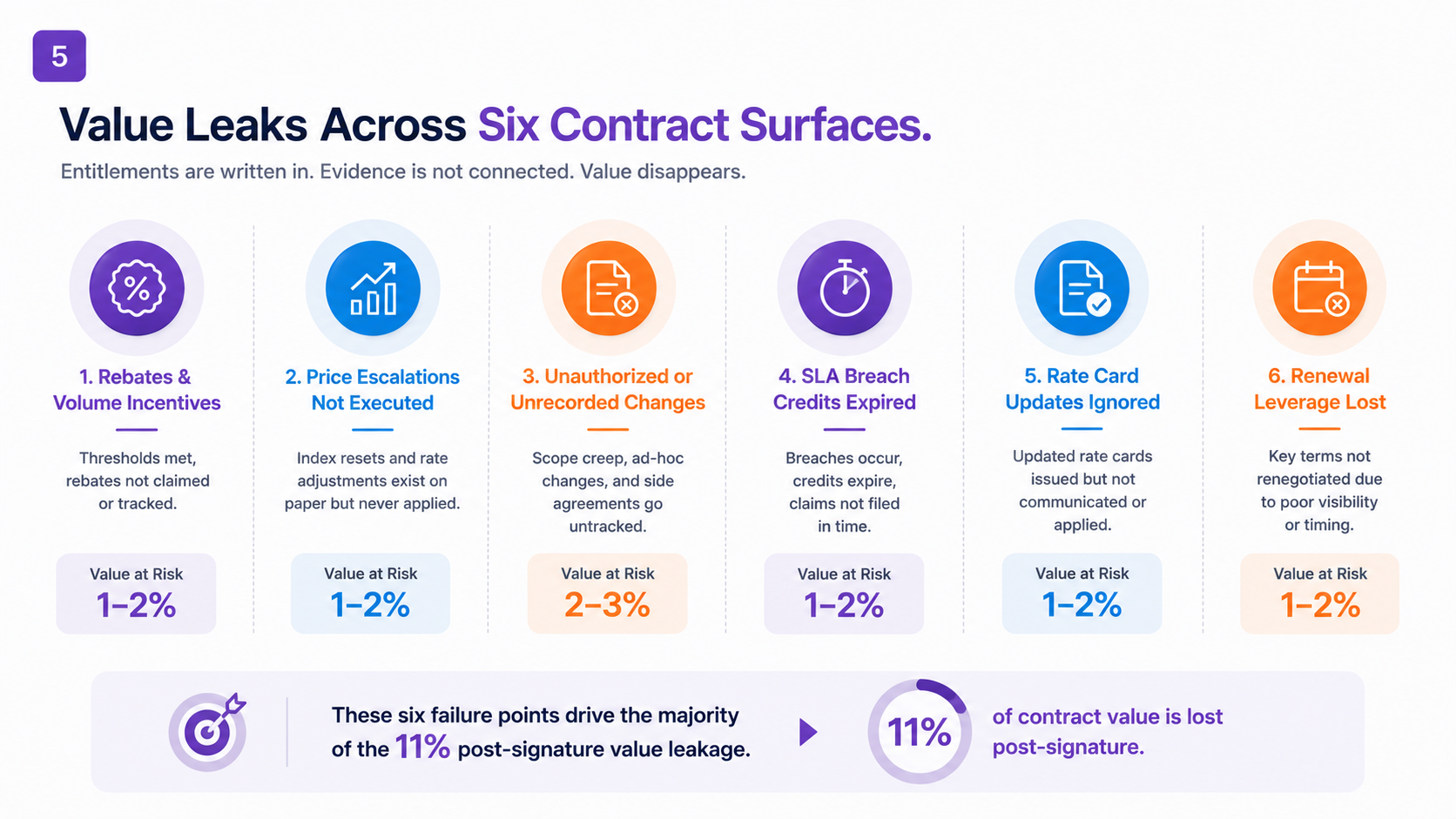
WorldCC's research identifies three structural failure types behind post-signature leakage: missed obligations (1 to 2% of contract value), price escalations not executed (1 to 2%), and unauthorized or unrecorded changes (2 to 3%). These three categories do not describe abstract risks. They describe specific things happening inside your contracts today, across six surfaces where value consistently disappears.
Rebates and volume incentives. Thresholds are met. Rebates are not claimed. The proof of entitlement lives in remittance data and delivery confirmations your contract system was never connected to.
Price escalations not executed. Index resets and rate adjustments exist on paper. They are never applied. Updated rate schedules live in PDF attachments nobody indexed against the contract.
Unauthorized or unrecorded changes. Scope creep, ad hoc modifications, and side agreements accumulate through the contract term. None are formally recorded. All quietly erode the original deal.
SLA breach credits expired. Breaches occur. Credit windows close before anyone files a claim. Performance data lives in IT monitoring systems that do not talk to the contract.
Rate card updates ignored. New rate cards are issued by suppliers. They are received but not communicated to the teams applying the old rates at invoicing.
Renewal leverage lost. Key terms go unrenegotiated because nobody had visibility into what was expiring, or when. The contract rolls over on the supplier's terms.
Each surface involves obligations whose enforcement evidence lives in data sources most contract management systems cannot read. Not because the systems are poor. Because they were never designed to read them.
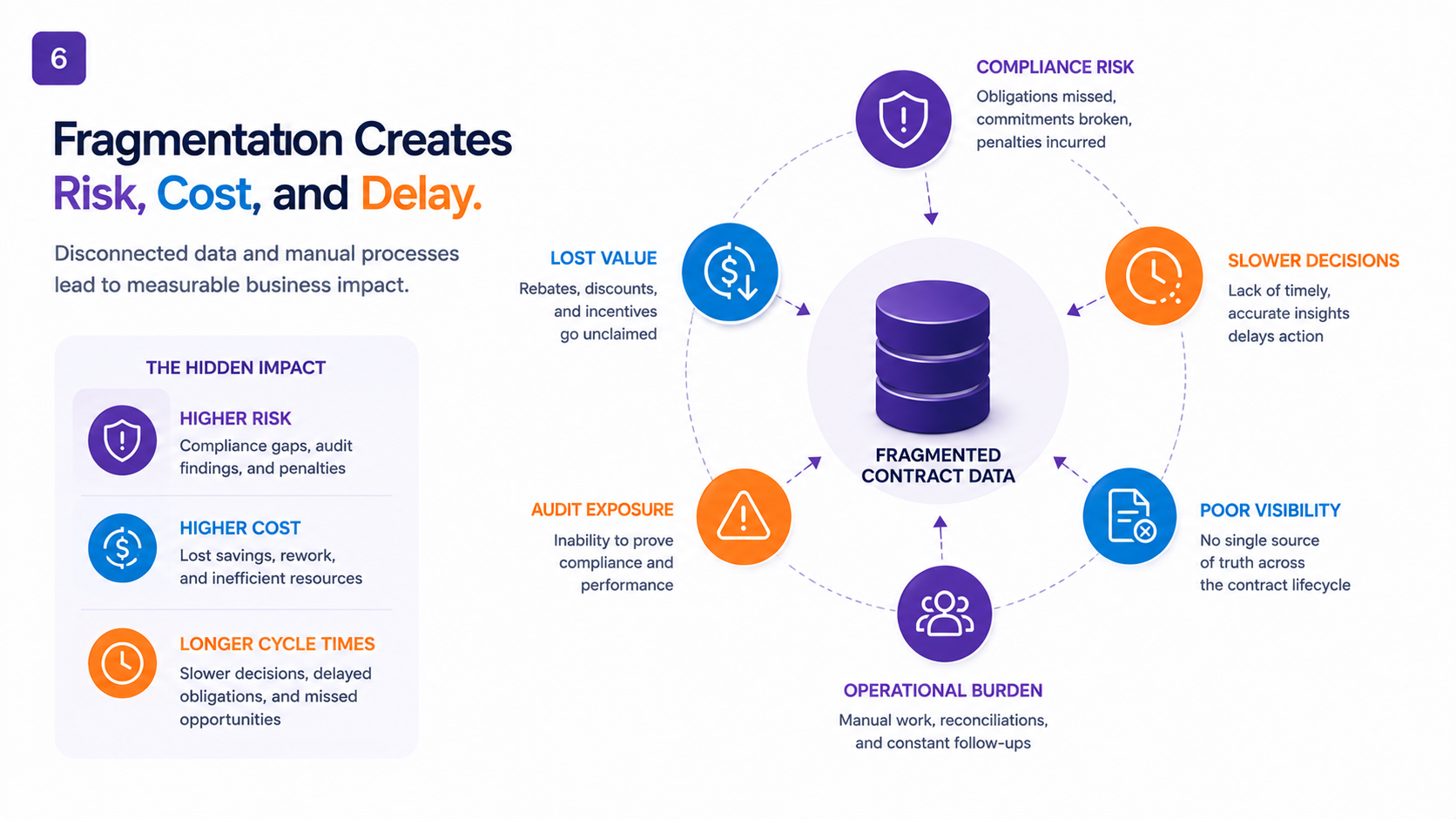
The 11% leakage figure captures the direct financial impact. It does not capture what surrounds it.
Fragmented contract data creates compliance risk: obligations missed, commitments broken, penalties incurred. It creates audit exposure: the inability to prove performance or compliance when it is requested. It creates operational burden: the manual reconciliations, constant follow-ups, and rework that consume the time of teams who should be managing supplier relationships rather than chasing evidence.
And it slows decisions. When the data required to enforce a contract obligation lives across five disconnected systems, the time between identifying a potential breach and acting on it is measured in months, not days. By the time anyone acts, the credit window has often already closed.
The visible cost is the $55 million leaking annually on $500 million of spend. The invisible cost is the operational overhead keeping it in place. Both are recoverable.
Obligation management is the discipline of tracking every commitment inside a contract from the point of signature to the point of expiry. Not just the document. The evidence required to enforce each obligation, claim each entitlement, and verify each deliverable. It addresses a single question: was every commitment inside this contract honoured, on both sides, and was every entitlement it created actually claimed?
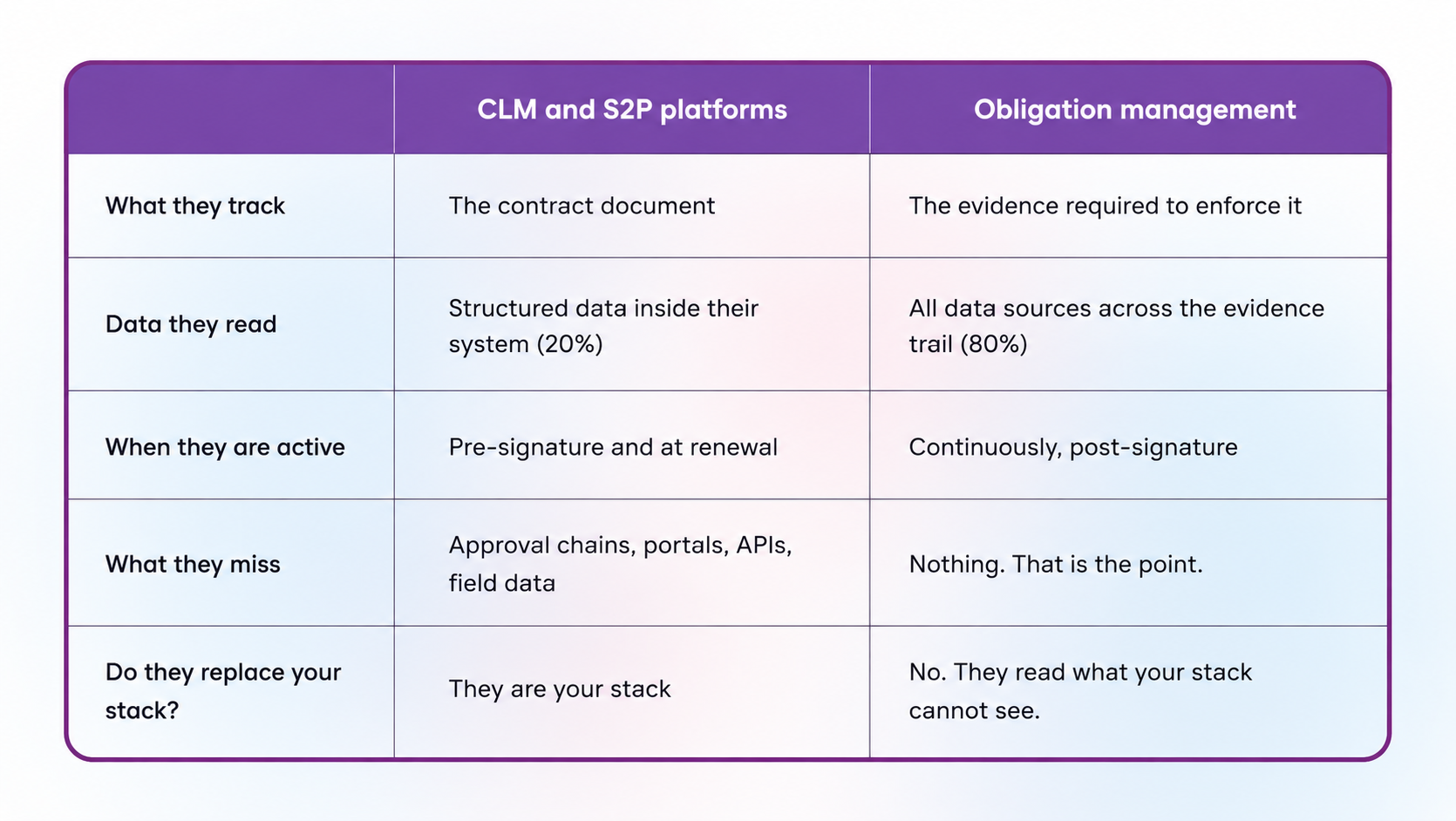
It is distinct from contract lifecycle management, which manages the contract document. It is distinct from spend management, which tracks what was purchased. Obligation management tracks whether what was agreed is actually happening.
Most enterprises cannot answer the obligation management question for more than a handful of their highest-profile contracts. For the rest of the portfolio, the answer is almost certainly no. And nobody has checked.
Closing the 11% gap is not a single action. It is a sequence. Assess where your obligations live and which surfaces carry the highest leakage risk. Standardise governance and ownership so that post-award accountability is explicit rather than assumed. Integrate the data sources holding your enforcement evidence so that obligations can be tracked continuously rather than audited retrospectively. Monitor in real time so that breach signals and entitlement windows surface when they can still be acted on. Then realise the value that was always there, waiting to be claimed.
WorldCC and Ironclad estimate that organisations modernising their contracting practices can recover between 2% and 3% of total spend in year one, rising to 5% to 10% over three years. On a $500 million spend base, that is $25 million to $50 million recoverable from contracts that already exist.
Zinger, built by Emplay, is the obligation management platform built for this sequence. It reads across the data sources your system of record was never designed to reach. It does not replace Ariba, Coupa, or your CLM. It adds what those platforms cannot see, which is the 80% of obligation evidence living outside them.
Closing the post-signature value gap does not just recover the leakage. It changes how contracts function across the organisation.
Value recovery becomes systematic rather than reactive. Compliance risk reduces because obligations are tracked in real time rather than audited after breaches have already occurred. Decisions accelerate because the data required to enforce or renegotiate a contract is visible rather than scattered. Supplier relationships strengthen because performance is measured against what was actually agreed, not what was informally remembered.
WorldCC's research shows that organisations managing contracts as financial instruments, actively tracking obligations through their lifecycle, outperform peers by approximately 5.4% of contract value. That is not aspirational. It is the compounding return on treating post-signature contract management as a discipline rather than an afterthought.
The organisations pulling ahead in procurement performance are not doing more sourcing. They are capturing more of the value they already negotiated.
See where your obligation management maturity sits against the industry benchmark. The assessment is at- https://emplayai-obligationmgmt-benchmark-report-2026.replit.app/
Five minutes. No stakeholder involvement required.
What causes post-signature contract value loss?
WorldCC identifies three structural failure types: missed obligations (1 to 2% of contract value), price escalations not executed (1 to 2%), and unauthorised or unrecorded changes (2 to 3%). The underlying cause in each case is the same: the evidence required to enforce the obligation lives outside the system tracking it.
Which contract types carry the highest obligation leakage risk?
Rate cards, rebate agreements, SLA-governed contracts, volume tier agreements, Master Service Agreements, and multi-year framework agreements consistently carry the highest risk. Each involves obligations whose enforcement evidence lives in data sources most contract management systems cannot read.
Is obligation management the same as contract lifecycle management?
No. Contract lifecycle management manages the contract document through its lifecycle. Obligation management tracks the enforcement evidence required to realise the value inside that document. CLM tells you what the contract says. Obligation management tells you whether what it says is actually happening.
How quickly can organisations recover post-signature contract value?
WorldCC estimates organisations can recover 2 to 3% of total spend in year one, rising to 5 to 10% over three years. McKinsey case study data shows that systematic contract reconciliation identifies approximately 4% of spend available for recovery negotiations. On $500 million of managed spend, that is $20 million recoverable in year one.
What does obligation management do that Ariba and Coupa do not?
Ariba, Coupa, and most S2P platforms manage the obligation data already structured inside their system: approximately 20% of the evidence trail a contract requires. Obligation management platforms read across the other 80%, which includes email approval chains, supplier portals, carrier APIs, and field confirmations. They do not replace those platforms. They add the visibility those platforms were never built to provide.
Sources: WorldCC and Ironclad, "Closing the Procurement Value Gap: How Smarter Contracting Can Prevent 11% Value Leakage," February 2026. McKinsey Global Procurement Survey, 2026. KPMG and Forbes Insights, 2025. Hackett Group Digital Procurement Study, July 2025. WorldCC contract performance research, 2025. SLA credit benchmark: industry practitioner playbook, 2026. McKinsey reconciliation case study via Execo, 2025. 80% data perimeter analysis: Emplay proprietary analysis of enterprise obligation portfolios, 2025 to 2026.
Sanchita Sur is the founder of Emplay and the builder of Zinger, the obligation management platform designed to read the 80% of contract evidence data that S2P and CLM platforms cannot see. Emplay is SAP-incubated and holds an Innovation of the Year award from Vodafone and Tomorrow Street. Connect on LinkedIn: linkedin.com/in/sanchita-sur-2a83764/
